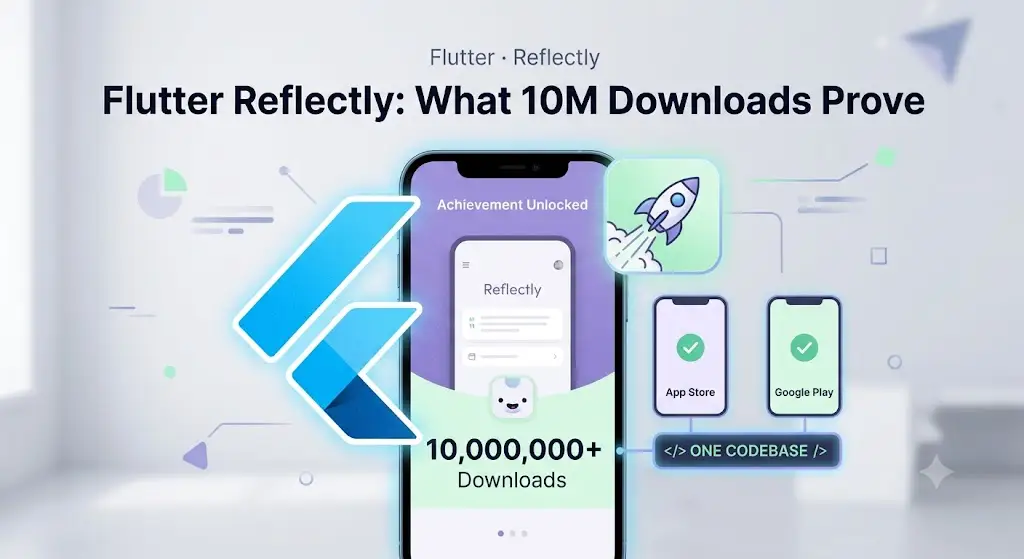
Flutter Reflectly is real-world evidence that Flutter can carry a consumer app to scale. Reflectly passed 10 million downloads without two separate native codebases. For pre-seed founders, that means one Flutter team can ship to both stores quickly, at a price you can survive.
The question that keeps showing up
It's 11 pm and you're doing startup homework. You read a case study about Reflectly. You see the 10 million downloads. You think, 'If Flutter can handle that, can it handle my MVP?'
That's the right question. The short answer is yes, with conditions.
Flutter Reflectly isn't a demo. It's a production app that went through App Store review, Play Store updates, active user sessions, and real device fragmentation. Those are the same obstacles your first build will face. The difference is that most MVP tools hide those obstacles until you're already committed.
Reflectly crossed 10 million downloads. So what?
Reflectly is one of the biggest consumer apps you can cite that runs on Flutter. That doesn't mean Flutter will make your app popular. It means Flutter isn't the reason apps stay small.
Look at the other names on Flutter's production list. Google Ads runs on Flutter. BMW's MyCar app runs in 30+ countries. Nubank, a major neobank, built on Flutter. Alibaba's Xianyu app reported a 70% faster development cycle after adopting it. Reflectly crossed 10 million downloads. Those aren't hobby projects. They're products with real users.
For a pre-seed founder, this matters because you can't afford to rebuild twice. Flutter gives you one codebase for Android and iOS. That's the whole point.
The 'Flutter is dying' narrative resurfaces on schedule
Stop me if you've heard this one. Someone posts 'Flutter is dying.' The tweet gets engagement. The framework keeps shipping.
This cycle comes around every 18 months. It's been wrong every time so far.
The data still points one way. Goodfirms found 46% of developers used Flutter in 2023, making it the most-used mobile framework that year. More than 2 million developers now build with it. There are roughly 500,000 Flutter apps on Google Play, and that number grows about 50% per year.
Those aren't signs of decline. They're signs of a framework that became the default answer for cross-platform development.
Flutter vs React Native: compare numbers, not vibes
Founders love the Flutter vs React Native argument. The mature answer is both work. The honest answer is the tradeoffs are different, and at your stage they're worth seeing clearly.
Here are the core numbers from Statista (October 2024) and Goodfirms:
| Factor | Flutter | React Native |
|---|---|---|
| --- | --- | --- |
| Rendering engine | Own engine (Impeller) | Bridges to native components |
| Language | Dart | JavaScript / TypeScript |
| Apps earning $10K-$100K/mo | 727 | 790 |
| Apps earning $1M+/mo | 37 | 55 |
| Developer adoption | 46% in 2023 | Historically dominant, declining share |
| Hot reload | Yes | Yes |
| Web/desktop support | Strong | Limited |
| Community size | 2M+ developers | Large, older ecosystem |
React Native still leads in revenue-earning apps right now. Flutter leads in developer adoption and is growing faster in the Play Store. When you're deciding, think about what matters most for your first release: one codebase, fewer bridge issues, and a faster path to a binary you can test. For a deeper look at what separates shipped apps from stuck ideas, read our guide to Flutter mobile app development in 2026.
What Reflectly doesn't prove
Let's be direct: Flutter didn't make Reflectly successful by itself. The team had product-market fit, retention loops, and distribution. Your framework won't replace those.
But those missing pieces don't invalidate the technical lesson. Reflectly proves Flutter can handle a consumer app at scale. That lets pre-seed founders stop spending cycles on framework debates and start spending them on the actual product.
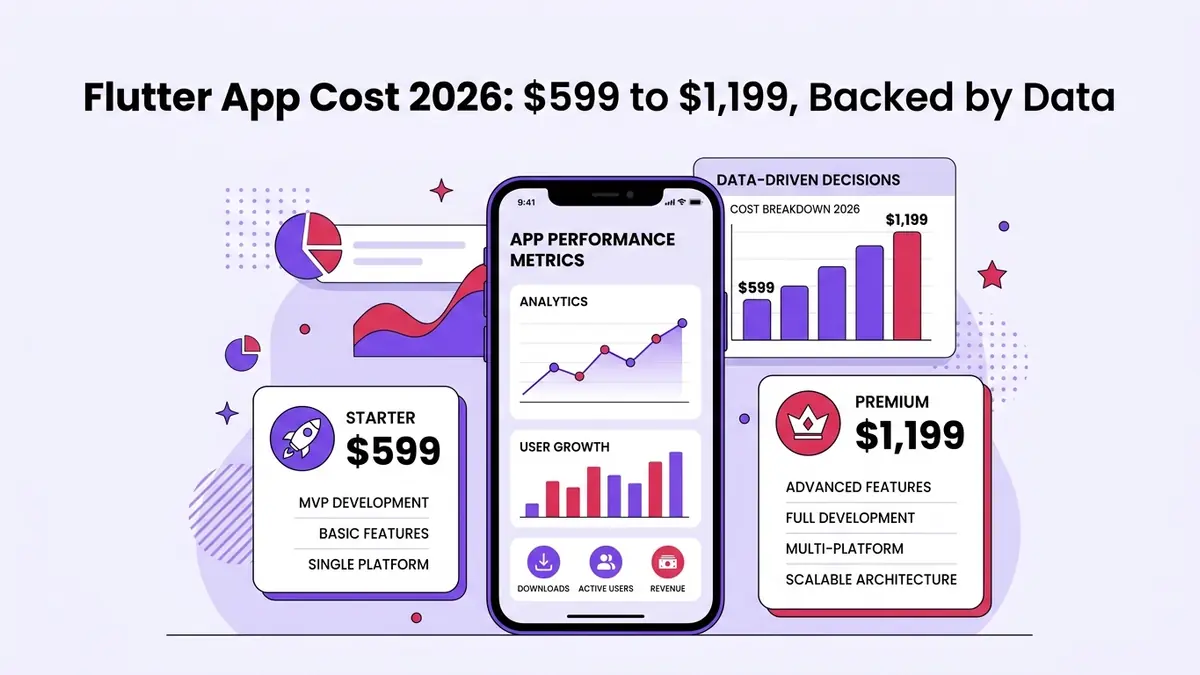
It also means you can push back on agencies that inflate scope. If you want a transparent look at what a real MVP should cost, check our Flutter app development cost guide before you sign anything.
AI tools are a prototype path, not a production path
Vibe-coding with Lovable, Bolt, or Cursor feels fast. You get a polished screen in an hour. Then you try to add real authentication. Or push notifications. Or a backend that survives 500 users.
That's when the prototype breaks.
This is the gap Flutterify exists to close. Mobile is the niche AI tools haven't cracked. AI can generate parts of a production app, but it can't guarantee App Store review, handle a real login flow, or scale with actual user sessions. The savings come from efficiency, not corner-cutting. AI belongs inside a disciplined build process, not as a replacement for one.
What a real Flutter MVP should look like
Here's what you should demand from any Flutter development partner:
- A working build on your real phone on day one. No mockups.
- App Store-ready in a defined timeline, not 'whenever'.
- Fixed scope, fixed price, no project managers padding hours.
- Full source code at the end, not a locked-up blob.
- A product that can survive real users, not just a demo video.
Before you compare agencies, read what nobody tells you before you sign a contract in our Flutter app development companies guide. It will save you a few painful meetings.
Why Reflectly beats another agency pitch
When an agency pitches you, they'll show you pretty screenshots. Reflectly gives you something better: proof that a Flutter app can reach tens of millions of downloads. The same reasons Reflectly picked Flutter, single codebase, fast iteration, and visual consistency, are why we recommend Flutter to pre-seed founders.
That doesn't mean every Flutter project succeeds. It means the framework is no longer a reason to fail. For founders shipping their first version, we're hard to beat on speed and price. Flutter Reflectly is the kind of case study that should make you curious, not cautious.
FAQ
Is Flutter Reflectly a realistic example for a pre-seed founder?
Yes, with context. Reflectly's 10 million downloads prove Flutter handles production scale. You still need product-market fit and distribution. But you no longer need to worry that Flutter will be the reason your app falls over when users actually show up.
How many apps are built with Flutter?
Roughly 500,000 Flutter apps live on Google Play, growing around 50% per year. Goodfirms measured 46% developer adoption in 2023, and the community has passed 2 million developers.
Should I choose Flutter or React Native?
Both work. Statista's October 2024 data shows React Native has more apps earning $10K–$100K per month (790 vs 727) and more apps earning $1M+ (55 vs 37). Flutter has 46% developer adoption, a 2M-developer community, and strong web/desktop support. For a new product shipping in 2026, Flutter's single codebase is usually the faster path.
Can I ship a production MVP with Lovable or Bolt?
You can prototype fast with them. You usually can't ship a production app from them because real auth, App Store submission, and scaling beyond a few hundred users break. A production Flutter MVP includes source code you own, a build on your phone, and a path to both stores.